Hypothalamic & Pituitary Drugs
ADH/Vasopressin, GnRH Analogues, Acromegaly, Prolactin Inhibitors & Gonadotropins — Mechanisms, Uses & Recent Advances
Past RGUHS + MPMSU + MUHS · 31
RGUHSSep '25
RGUHSDec '23
RGUHSJul '23
MPMSUJun '23
MUHSWinter '23
MUHSSummer '23
MPMSU2022
RGUHSJul '21
RGUHSJun '20
MUHSWinter '20
RGUHSMay '19
MUHSSummer '19
RGUHSMay '18
RGUHSMay '18
MPMSU2018
MUHSSummer '18
MPMSU2015
MPMSU2015
MPMSU2015
MUHSSummer '15
MUHSWinter '15
MUHSWinter '15
MPMSU2014
MUHSWinter '14
MPMSU2012
RGUHSMay '11
RGUHSMay '10
RGUHSMay '09
RGUHSOct '08
RGUHSApr '07
RGUHSApr '06
Introduction & the hypothalamic-pituitary axis
- Scope — Metabolism, growth and reproduction are controlled by an integrated hypothalamic-pituitary neuroendocrine unit; drugs in this class either replace a deficient hormone, antagonise an over-produced one, or are used for diagnostic testing.
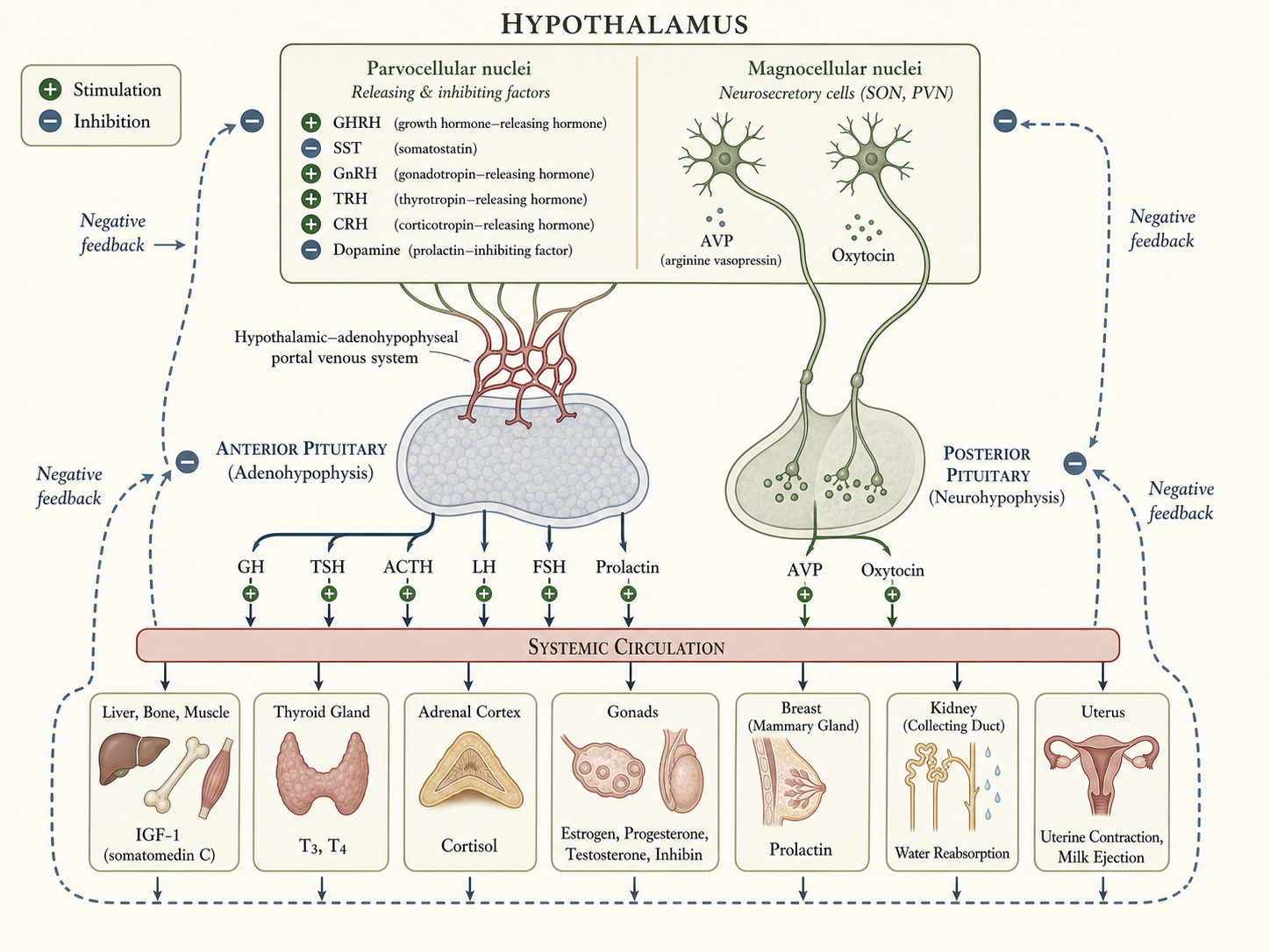
- Two lobes — Anterior pituitary (adenohypophysis) — secretes GH, prolactin, TSH, ACTH, LH & FSH under hypothalamic releasing/inhibiting hormones delivered by the hypothalamic-adenohypophyseal portal system. Posterior pituitary (neurohypophysis) — not a true gland but axon terminals of magnocellular SON/PVN neurons storing & releasing oxytocin and vasopressin (AVP/ADH).
- Axis architecture — hypothalamic releasing hormone → amplified by an anterior-pituitary trophic hormone → target-endocrine-organ response → target hormone exerts negative feedback on both hypothalamus and pituitary.
- Clinically important drug groups — GH & GH-antagonists, somatostatin analogues, dopamine agonists, gonadotropins, GnRH (and analogues), oxytocin, and vasopressin/desmopressin — most pure hypothalamic peptides (TRH, CRH, GHRH) are used only diagnostically because the downstream target hormone is easier to give.
Continue reading
See plans
Hypothalamic Pituitary Drugs
PharmaNotes Pro · LAQ
₹199/monthMonthly
Save 16%₹1,999/yearAnnual
- Every LAQ and Comprehensive chapter, current and future
- Exam Prep: guided recall, recorded audio and nine PDFs
- The RGUHS recurring-question answer bank, Papers I–IV
Sign in with your Google account. If you're already subscribed, the chapter unlocks immediately — otherwise, pick Monthly or Annual on the next step.