Blinding, Randomization & Allocation Concealment in Clinical Trials
The three pillars of internal validity in randomized controlled trials
Past RGUHS + DNB + MPMSU + MUHS + VNSGU · 16
RGUHSSep '25
RGUHSMay '25
MPMSUJan '25
DNBDec '25
MUHSWinter '25
MPMSUJun '23
DNBOct '23
MPMSU2022
DNBDec '22
VNSGUApr '22
RGUHSNov '21
RGUHSNov '18
MPMSUJun '17
RGUHSMay '10
MPMSU2009
RGUHSSep '07
Introduction & the three pillars
- RCT as gold standard — A properly designed and conducted randomized blinded trial (RCT) provides the most definitive causal inference in evidence-based medicine, and is the basis on which a drug demonstrates the efficacy/safety needed for a marketing licence.
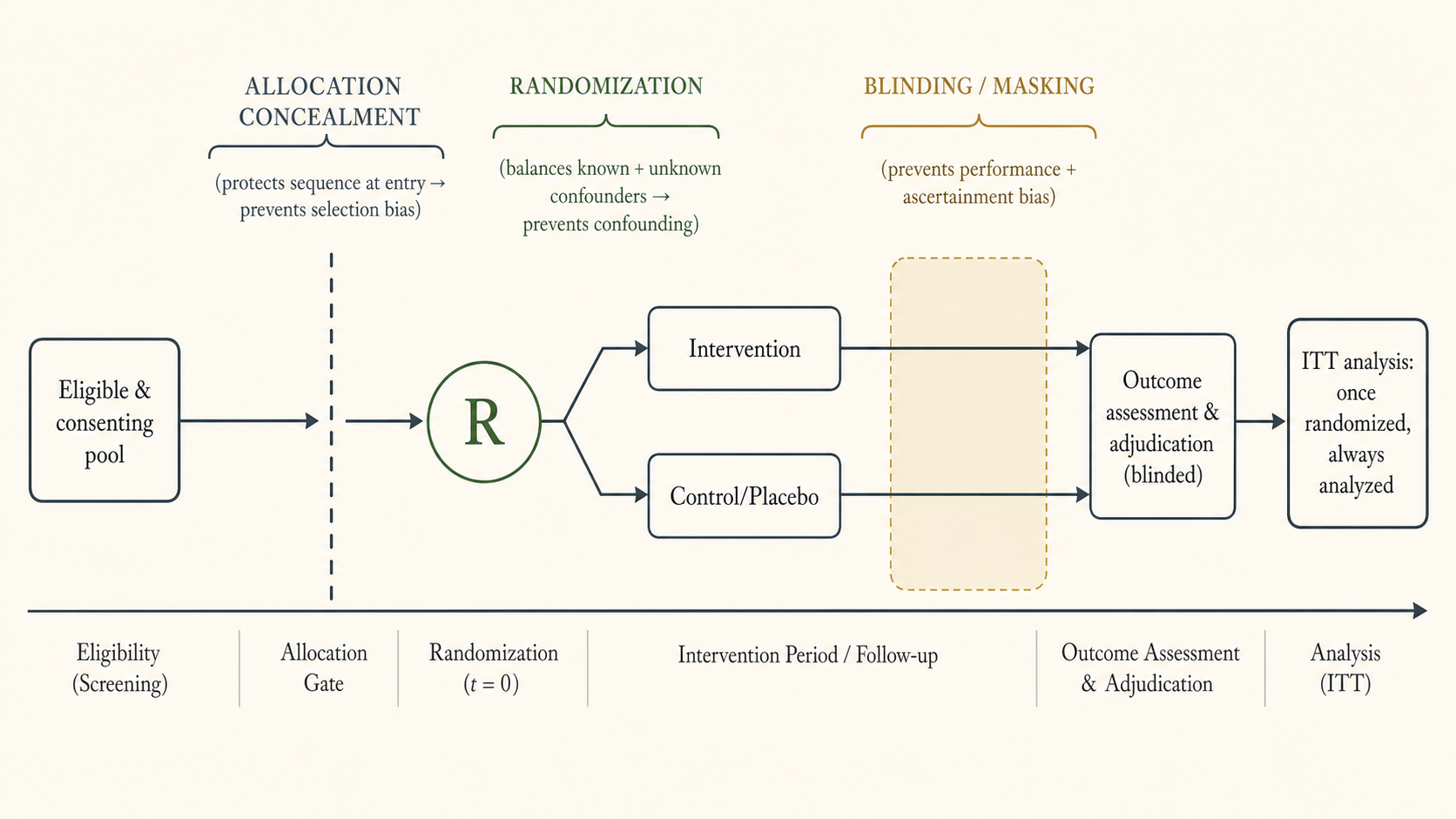
- The two key bias-avoidance techniques — Randomisation and blinding together avoid bias in the selection/allocation of subjects and in the measurement/assessment of outcomes; allocation concealment is the third safeguard that protects the random sequence at the moment of enrolment.
- Randomization — use of chance/probability to assign treatment so no assignment is known with certainty beforehand — minimises confounding from variables that are even unknown or unmeasured by distributing them equally (except for chance) across arms.
- Blinding (masking) — prevents knowledge of the assigned treatment from biasing results — minimises differential placebo effects, differential cointerventions, and biased ascertainment/adjudication of outcomes.
- Allocation concealment — whether the identity of the next patient's treatment is known to those recruiting — protects integrity of the random sequence at enrolment; distinct from blinding.
- Key conceptual separation (high-yield) — allocation concealment operates before/at randomization (guards against selection bias in who is enrolled into which arm); blinding operates after randomization (guards against performance, ascertainment & cointervention/placebo bias during follow-up).
- Equipoise — the ethical precondition for randomizing — genuine collective uncertainty (the "uncertainty principle") as to which arm is best, so each participant has equal potential for benefit and risk.
- Empirical proof these matter — across analyses of many trials, treatment effects are systematically smaller (closer to truth) when double-blinded, and are exaggerated where allocation is poorly concealed — not optional niceties but bias-control essentials.
❦
Continue reading
See plans
Blinding Randomization Allocation
PharmaNotes Pro · LAQ
₹199/monthMonthly
Save 16%₹1,999/yearAnnual
- Every LAQ and Comprehensive chapter, current and future
- Exam Prep: guided recall, recorded audio and nine PDFs
- The RGUHS recurring-question answer bank, Papers I–IV
Sign in with your Google account. If you're already subscribed, the chapter unlocks immediately — otherwise, pick Monthly or Annual on the next step.