Management of Anticancer Drug Toxicity
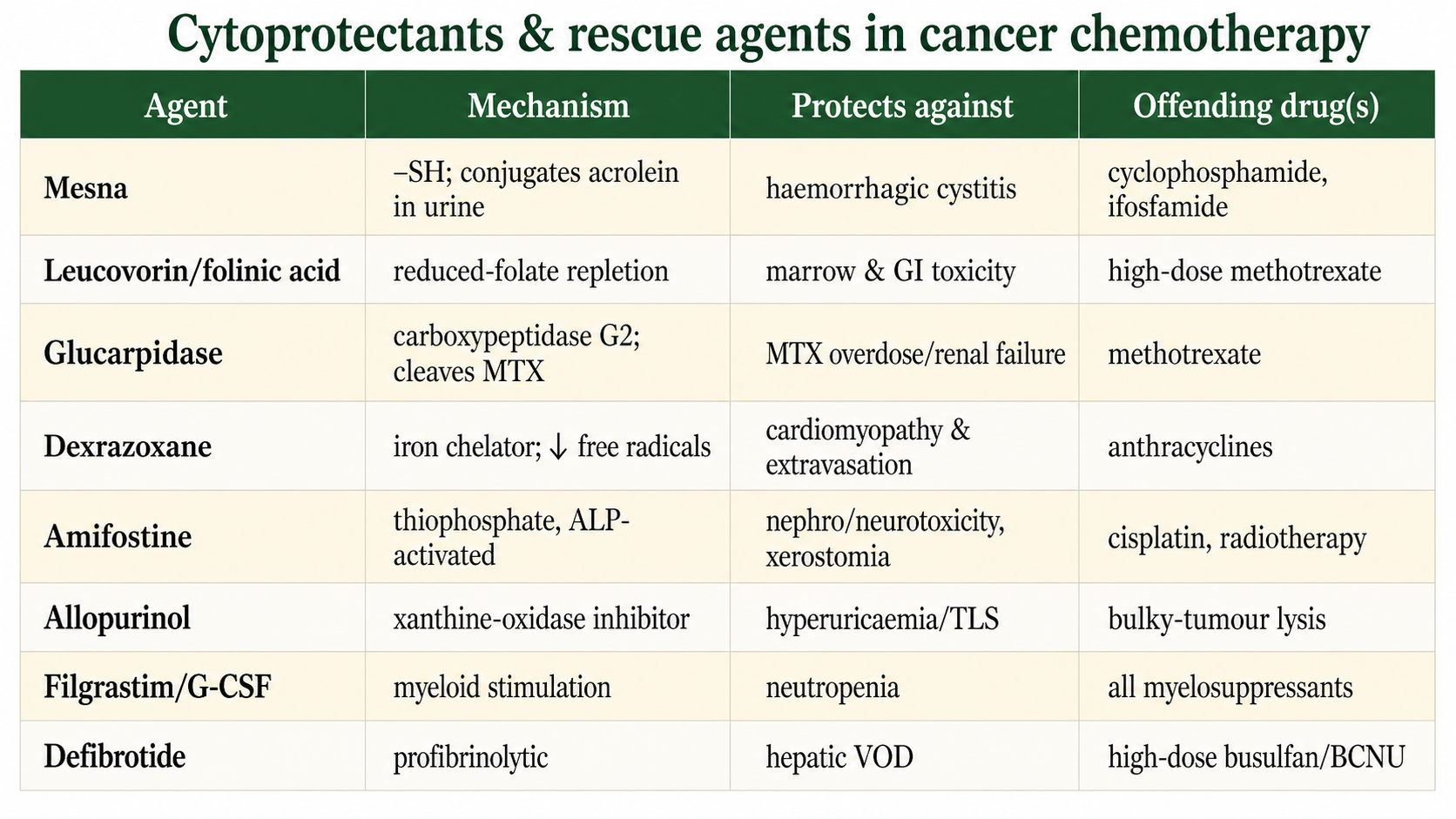
The Selectivity Problem & Class-Wide Cytotoxic Toxicities · Myelosuppression & Growth-Factor Support · CINV · Mucositis · Alopecia · Anthracycline Cardiotoxicity (Dexrazoxane) · Haemorrhagic Cystitis (Mesna) · Platinum Nephro/Oto-toxicity (Hydration, Amifostine) · Methotrexate Rescue (Leucovorin, Glucarpidase) · Neuro/Pulmonary/Hepatic Toxicity · Extravasation · Tumour-Lysis Syndrome · Toxicity-Amelioration Checklist · Pharmacogenetic Predictors · Indian Context
Past RGUHS + MPMSU + MUHS · 10
RGUHSDec '23
RGUHSJul '23
RGUHSNov '21
MUHSSummer '21
RGUHSNov '20
MPMSUMay '19
MPMSU2017
MUHSSummer '17
MPMSU2015
MUHSWinter '15
Introduction — why anticancer drugs are uniquely toxic
- The narrowest therapeutic index in therapeutics — anticancer drugs are one of the most toxic classes in all of medicine — few categories have a narrower therapeutic index; dose-limiting host toxicity is the rule.
- The selectivity problem — malignant cells are host cells with deranged growth regulation and only minor biochemical differences from normal cells, so the selectivity of cytotoxics is inherently limited.
- High-growth-fraction tissues bear the brunt — classical cytotoxics act preferentially on rapidly multiplying cells (targets are nucleic acids/precursors), so the normal tissues with the highest growth fraction suffer most — bone marrow, oral & GI mucosa, reticuloendothelial system, hair follicles and gonads. Toxicity is largely dose-dependent and predictable for a given drug.
- Cell-cycle context — cell-cycle non-specific (CCNS) drugs (alkylators, nitrosoureas, cisplatin, antitumour antibiotics) kill resting and dividing cells; cell-cycle specific (CCS) drugs kill only dividing cells (antimetabolites in S, vinca/taxanes in M) — giving CCS drugs in short pulses lets non-cycling normal cells recover and is itself a toxicity-sparing strategy.
- Governing principle — recognise toxicity early, alter doses or discontinue the offending drug, and give vigorous supportive care — toxicities affecting the heart, lungs, nervous system or kidneys may be irreversible if recognised late.
Continue reading
See plans
Anticancer Drugs Toxicity Management
PharmaNotes Pro · LAQ
₹199/monthMonthly
Save 16%₹1,999/yearAnnual
- Every LAQ and Comprehensive chapter, current and future
- Exam Prep: guided recall, recorded audio and nine PDFs
- The RGUHS recurring-question answer bank, Papers I–IV
Sign in with your Google account. If you're already subscribed, the chapter unlocks immediately — otherwise, pick Monthly or Annual on the next step.