SERMs, SERDs & Tocolytics
Tissue-Selective Estrogen-Receptor Pharmacology & Uterine Relaxants
Past RGUHS + MPMSU + VNSGU · 13
RGUHSMay '25
RGUHSMay '25
VNSGUJan '25
RGUHSMay '22
RGUHSNov '21
RGUHSJul '21
MPMSUAug '21
RGUHSNov '20
MPMSUMay '18
RGUHSJun '16
RGUHSOct '10
RGUHSOct '08
RGUHSApr '06
SERMs, SERDs & Tocolytics
1. Definition, scope & estrogen-receptor framework
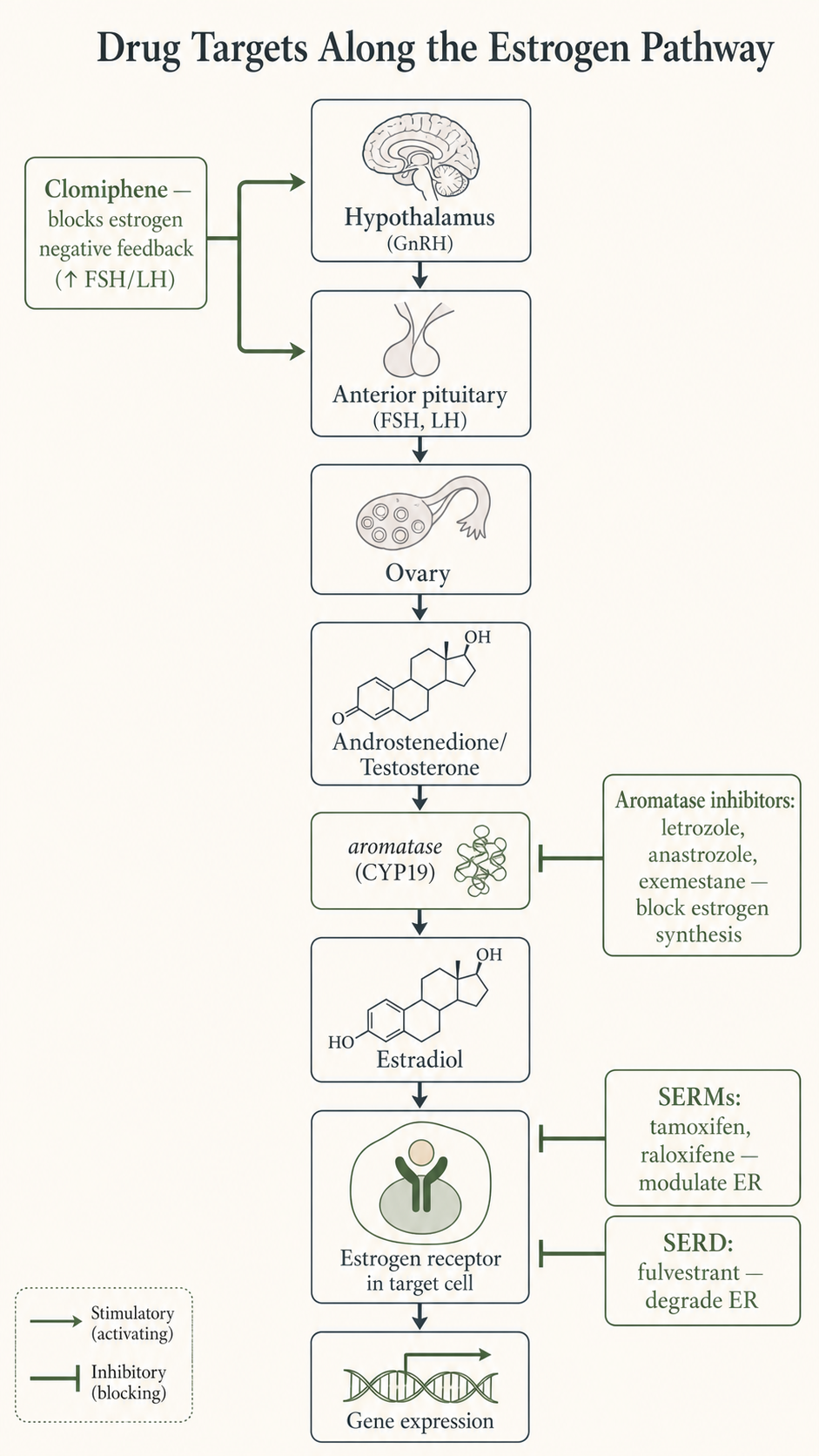
- Selective estrogen receptor modulators (SERMs) are compounds that exert estrogenic (agonist) actions in some tissues and antiestrogenic (antagonist) actions in others — tissue-selectively rather than acting as uniform agonists or antagonists (KDT 8e Ch.22, pp.337–9).
- The pharmacological goal of a SERM is to produce beneficial estrogenic actions in tissues such as bone, brain and liver while exerting antagonist activity in breast and endometrium, where estrogenic stimulation (e.g. carcinogenesis) is deleterious (G&G 14e Ch.48, pp.967–8).
- The whole class is built on a spectrum of receptor activities — from purely antiestrogenic in all tissues, to partially estrogenic in some tissues with antagonist/no activity in others, to purely estrogenic in all tissues — depending on how the ligand alters ER conformation (G&G 14e Ch.48, p.967).
- Estrogens act via two nuclear-receptor isoforms: ERα (gene ESR1) and ERβ (gene ESR2), located on separate chromosomes; the two human ERs are only ~44% identical overall but highly homologous in the DNA-binding domain, so they regulate many of the same target genes (G&G 14e Ch.48, p.965).
- ERα predominates in the female reproductive tract (uterus, vagina, ovary), mammary gland, hypothalamus, endothelium and vascular smooth muscle; it is the form chiefly responsible for growth regulation in breast cancer (G&G 14e Ch.48, p.965).
- ERβ predominates in prostate and ovary, with lower expression in lung, brain, bone and vasculature; when co-expressed it can inhibit ERα-mediated transcription (G&G 14e Ch.48, p.965).
- A distinct membrane G-protein-coupled estrogen receptor, GPER (formerly GPR30), mediates some rapid (non-genomic) estrogen effects; its definitive physiological role in vivo remains unsettled (G&G 14e Ch.48, p.965).
- Terminology to keep straight (high-yield exam distinction):
- SERM = mixed agonist/antagonist, tissue-selective (tamoxifen, raloxifene, toremifene, ormeloxifene, bazedoxifene) (KDT 8e Ch.22, p.338).
- Antiestrogen (pure antagonist) = antagonist in all tissues studied — clomiphene and fulvestrant are grouped here by G&G (G&G 14e Ch.48, p.967).
- SERD (selective estrogen receptor down-regulator / pure estrogen antagonist) = fulvestrant — distinguished from SERMs because it down-regulates (degrades) the ER rather than merely modulating it (KDT 8e Ch.22, p.337).
- Aromatase inhibitor (AI) = blocks estrogen synthesis (letrozole, anastrozole, exemestane) — not an ER ligand at all (KDT 8e Ch.22, pp.339–40).
Continue reading
See plans
Serms Serds
PharmaNotes Pro · Comprehensive
₹199/monthMonthly
Save 16%₹1,999/yearAnnual
- Every LAQ and Comprehensive chapter, current and future
- Exam Prep: guided recall, recorded audio and nine PDFs
- The RGUHS recurring-question answer bank, Papers I–IV
Sign in with your Google account. If you're already subscribed, the chapter unlocks immediately — otherwise, pick Monthly or Annual on the next step.