Placebo & the Placebo Effect
Definition, biology, the placebo reactor & nocebo, the placebo-control arm, blinding, trial designs and ethics — an RGUHS methodology LAQ
Past RGUHS + DNB + MPMSU + MUHS + VNSGU · 23
RGUHSSep '25
DNBJun '25
DNBMay '24
RGUHSMay '22
DNBJun '22
VNSGUJun '21
RGUHSJun '20
MPMSUJul '20
DNBJun '20
RGUHSNov '19
RGUHSMay '19
MPMSU2018
MUHSSummer '18
RGUHSNov '16
MPMSU2015
MUHSSummer '15
MPMSU2014
MUHSSummer '14
RGUHSMay '11
RGUHSMay '11
MPMSU2007
MPMSU2005
MPMSU1995
Placebo & the Placebo Effect
1. Definition, etymology & terminology
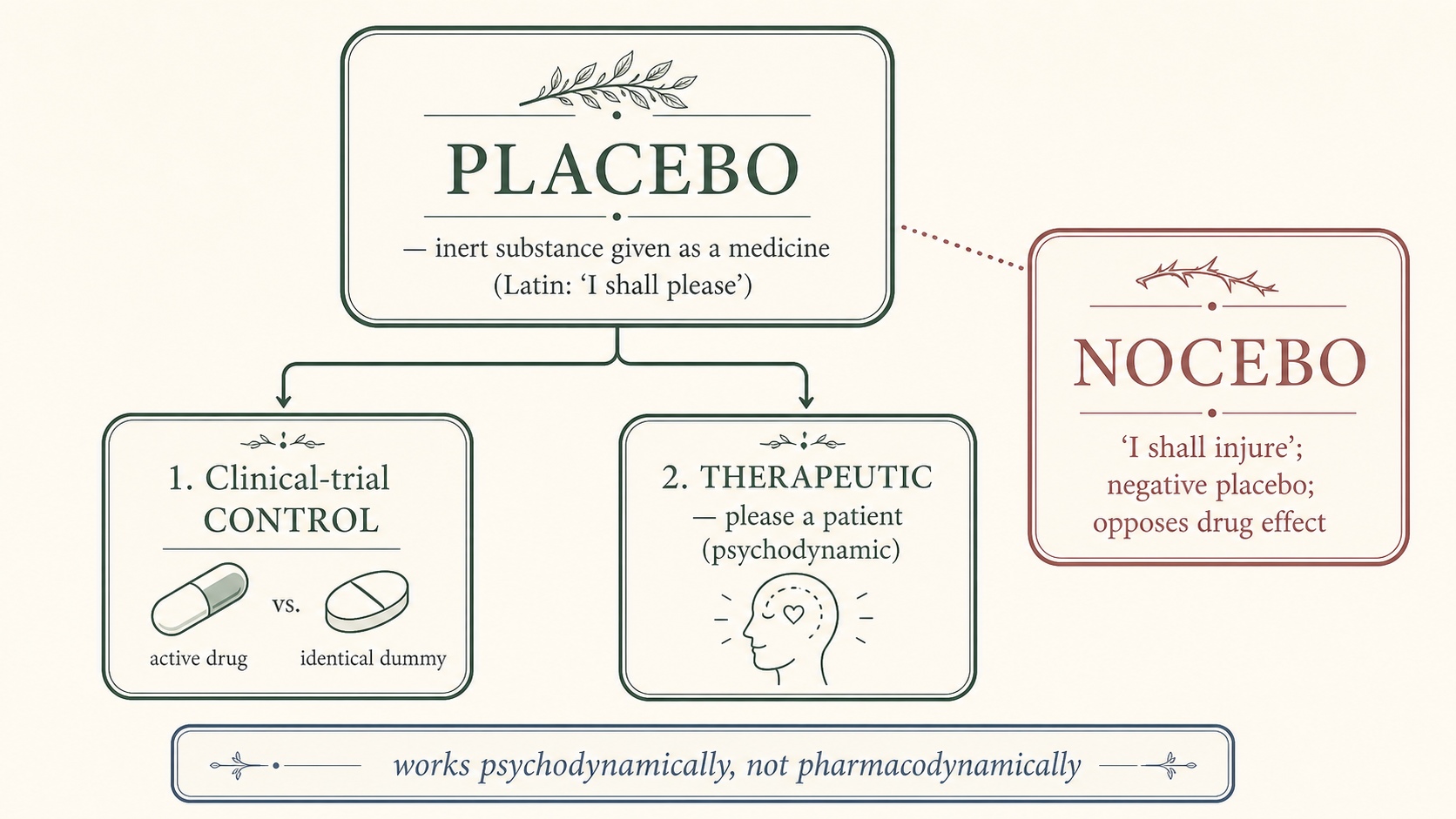
- A placebo is any component of therapy that is without specific biological activity for the condition being treated — the standard clinical-pharmacology definition; it is not limited to a sugar pill but extends to any inert vehicle for treatment by suggestion (B&B Ch 2, p.15).
- KDT's exam-tuned definition: a placebo is "an inert substance which is given in the garb of a medicine"; it works by psychodynamic (not pharmacodynamic) means and "often produces responses equivalent to the active drug" (KDT 8e Ch 5, p.77).
- Etymology — placebo is Latin for "I shall please" (more fully "shall be pleasing or acceptable"); the patient responds to the whole therapeutic setting, and the placebo effect largely depends on the physician–patient relationship (KDT 8e Ch 5, p.77; B&B Ch 2, p.15 footnote).
- A placebo medicine is a vehicle for 'cure' by suggestion, and is surprisingly often successful, if only temporarily (B&B Ch 2, p.15).
- The placebo effect is the (favourable) psychological/physiological response to the act of medication itself rather than to any pharmacological action; the placebo response (G&G's term) may involve objective physiologic and biochemical changes as well as changes in subjective complaints (Katzung 16e Ch 1, p.14).
- Nocebo (Latin: nocebo = "I shall injure") is the converse of placebo — the negative psychodynamic effect, an adverse response evoked by a pessimistic patient attitude or loss of faith in the medication/physician; the nocebo effect can oppose the therapeutic effect of active medication (KDT 8e Ch 5, p.78; B&B Ch 2, p.15 — "negative placebo or nocebo effect").
- The nocebo term is little used in the older literature, but is the standard term for placebo-associated adverse events — subjective "toxicity" such as stomach upset, insomnia, sedation (B&B Ch 2, p.15; Katzung 16e Ch 1, p.14).
- All treatments carry a placebo component — physiotherapy, psychotherapy, surgery, entering a patient into a therapeutic trial, even the personality and style of the doctor — but the effect is most easily investigated with drugs, because the active drug and the inert dummy can be made to appear identical, allowing controlled comparison (B&B Ch 2, p.15).
Continue reading
See plans
Placebo
PharmaNotes Pro · Comprehensive
₹199/monthMonthly
Save 16%₹1,999/yearAnnual
- Every LAQ and Comprehensive chapter, current and future
- Exam Prep: guided recall, recorded audio and nine PDFs
- The RGUHS recurring-question answer bank, Papers I–IV
Sign in with your Google account. If you're already subscribed, the chapter unlocks immediately — otherwise, pick Monthly or Annual on the next step.