Perinatal Pharmacology
Placental Drug Transfer, Gestational and Fetal Pharmacokinetics, Drugs in Labour and the Neonatal Transition
Past RGUHS · 2
RGUHSDec '23
RGUHSJul '23
Perinatal Pharmacology
1. Definition, scope and why perinatal pharmacology is a separate discipline
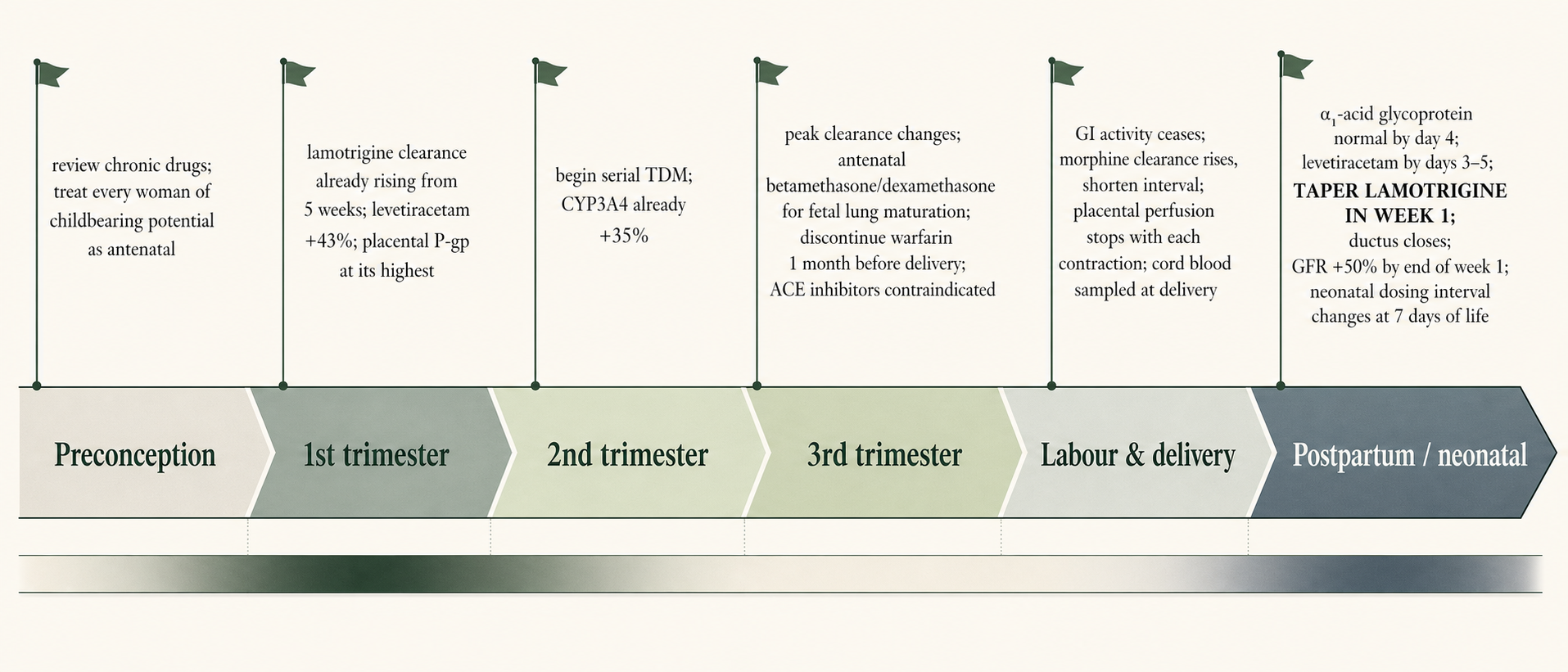
- Perinatal pharmacology is the study of drug disposition and drug action across the maternal–placental–fetal unit and through the neonatal transition — i.e. how a drug given to a pregnant woman reaches, is handled by, and acts on the fetus, and how the newly born infant handles drugs during the abrupt physiological reorganisation of birth (Katzung 16e Ch.59, pp.1109–19).
- The general pharmacokinetic and pharmacodynamic principles are unchanged; what changes is the physiological context in which they operate — a pregnant woman with a 40% expanded plasma volume and a 50% higher cardiac output, and a rapidly maturing infant, are not "small adults" or "adults plus a passenger" (Katzung 16e Ch.59, p.1109).
- Pharmacokinetic understanding in this population is now reasonably advanced; pharmacodynamic knowledge (receptor number, density, coupling, response) remains grossly incomplete for both fetus and neonate — this asymmetry is the single most important honest caveat in the field (Katzung 16e Ch.59, p.1109).
- The pregnant woman has been called "the last true therapeutic orphan" — ethical, medicolegal and fetal-safety concerns mean very few pharmacokinetic, pharmacodynamic or clinical trials are performed in pregnancy, so most labels still carry the formula "there are no adequate and well-controlled studies in pregnant women… use during pregnancy only if clearly needed" (Atkinson 5e Ch.23, p.425).
- The parallel paediatric formulation is Harry Shirkey's 1968 editorial: "By an odd and unfortunate twist of fate, infants and children are becoming therapeutic or pharmaceutical orphans" — regulatory laws written to protect children after therapeutic disasters instead excluded them from study and produced labels saying "not recommended for paediatric use" (Atkinson 5e Ch.24, pp.455–6).
- Two compelling reasons are advanced for actually studying drugs in pregnancy (Atkinson 5e Ch.23, p.425):
- The rising age of first pregnancy — more women enter pregnancy with pre-existing chronic disease requiring continued therapy.
- The physiological changes of gestation themselves alter absorption, protein binding, distribution volume and renal/hepatic clearance, so simple extrapolation of non-pregnant kinetics is unsafe and may cause either treatment failure or maternal toxicity, with downstream effects on pregnancy outcome.
- The practical consequence of the evidence vacuum is a systematic clinical bias: pregnant women are more often left untreated than treated, and the risk of the untreated maternal disease on the pregnancy and the offspring is usually not weighed at all; when therapy is started, the usual adult dose is prescribed without any thought to gestational physiology (Atkinson 5e Ch.23, p.425).
- Two counselling anchors that quantify the field (Katzung 16e Ch.59, pp.1113–4):
- The baseline (background) teratogenic risk of any pregnancy — a neonatal abnormality with no known teratogenic exposure — is about 3%.
- Fewer than 30 drugs have been proven human teratogens, against hundreds proven safe; the reflexive assumption that "every drug is a potential teratogen" is itself harmful, and appropriate counselling has documented ability to prevent unnecessary terminations.
- Untreated disease carries its own fetal risk: women who discontinued SSRI therapy for depression in pregnancy out of teratogenicity fear have shown serious morbidity, and untreated hypertension of pregnancy itself raises major-malformation rates (Katzung 16e Ch.59, pp.1113–4).
- Indian framing (Padmaja 7e Ch.63, p.735): the practical rule taught for the Indian graduate is that drugs should generally be avoided in pregnancy and used cautiously with an explicit risk–benefit balance for both mother and child; for most common diseases one or two agents with an established safety record exist (e.g. methyldopa for hypertension, chloroquine for malaria) and the prescriber should know or consult that list rather than improvise.
Continue reading
See plans
Perinatal Pharmacology
PharmaNotes Pro · Comprehensive
₹199/monthMonthly
Save 16%₹1,999/yearAnnual
- Every LAQ and Comprehensive chapter, current and future
- Exam Prep: guided recall, recorded audio and nine PDFs
- The RGUHS recurring-question answer bank, Papers I–IV
Sign in with your Google account. If you're already subscribed, the chapter unlocks immediately — otherwise, pick Monthly or Annual on the next step.