General Anaesthetics
Inhalational & Intravenous Agents — Mechanisms, MAC, Stages, Balanced Anaesthesia & Recent Advances
Past RGUHS + DNB + MPMSU · 8
RGUHSMar '26
RGUHSSep '25
RGUHSJul '21
RGUHSJun '20
DNBDec '15
RGUHSOct '09
MPMSU2009
RGUHSOct '08
General Anaesthetics
1. Definition & components of the anaesthetic state
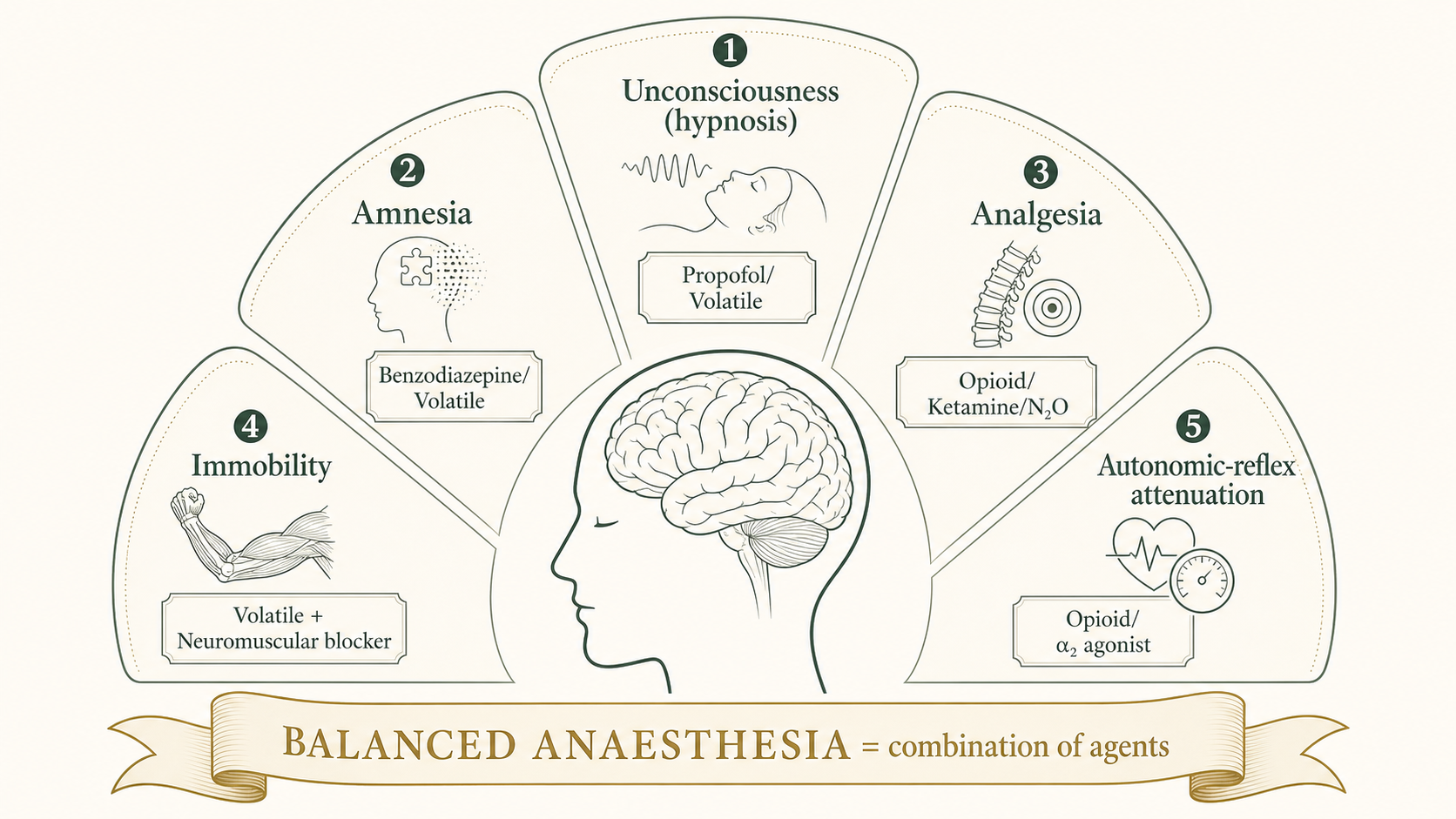
- General anaesthetics (GAs) are drugs that produce a reversible loss of all sensation and consciousness, with a low therapeutic index, used to permit surgery and unpleasant procedures (KDT 8e Ch.27, p.399; G&G 14e Ch.24, p.471).
- The cardinal features ("components") of general anaesthesia are five distinct end points — no single available agent achieves all five well (Katzung 16e Ch.25, p.464; G&G 14e Ch.24, p.472):
- Unconsciousness (hypnosis)
- Amnesia (loss of recall of perioperative events)
- Analgesia (loss of pain sensation)
- Immobility / inhibition of motor response to noxious (surgical) stimulation
- Attenuation of autonomic reflexes (and skeletal-muscle relaxation) (Katzung 16e Ch.25, p.464).
- Because no one drug delivers all components safely, modern practice uses balanced anaesthesia — a combination of inhaled and intravenous drugs, each chosen for a specific component (induction agent, maintenance agent, opioid analgesic, neuromuscular blocker), exploiting favourable properties while minimising the side effects of each (KDT 8e Ch.27, p.399; Katzung 16e Ch.25, p.464).
- The three overarching objectives of general-anaesthesia delivery are (G&G 14e Ch.24, p.471):
- Minimise the direct/indirect deleterious effects of the agents and techniques.
- Sustain physiological homeostasis during surgery (blood loss, ischaemia–reperfusion, fluid shifts, cold exposure, impaired coagulation).
- Improve post-operative outcome by blunting the surgical stress response.
Continue reading
See plans
General Anaesthetics
PharmaNotes Pro · Comprehensive
₹199/monthMonthly
Save 16%₹1,999/yearAnnual
- Every LAQ and Comprehensive chapter, current and future
- Exam Prep: guided recall, recorded audio and nine PDFs
- The RGUHS recurring-question answer bank, Papers I–IV
Sign in with your Google account. If you're already subscribed, the chapter unlocks immediately — otherwise, pick Monthly or Annual on the next step.