Pharmacotherapy of Cough
Antitussives, Expectorants & Mucolytics
Past RGUHS · 5
RGUHSMay '25
RGUHSJul '21
RGUHSMay '18
RGUHSOct '08
RGUHSApr '06
Pharmacotherapy of Cough
1. Cough as a protective reflex — definition & rationale for therapy
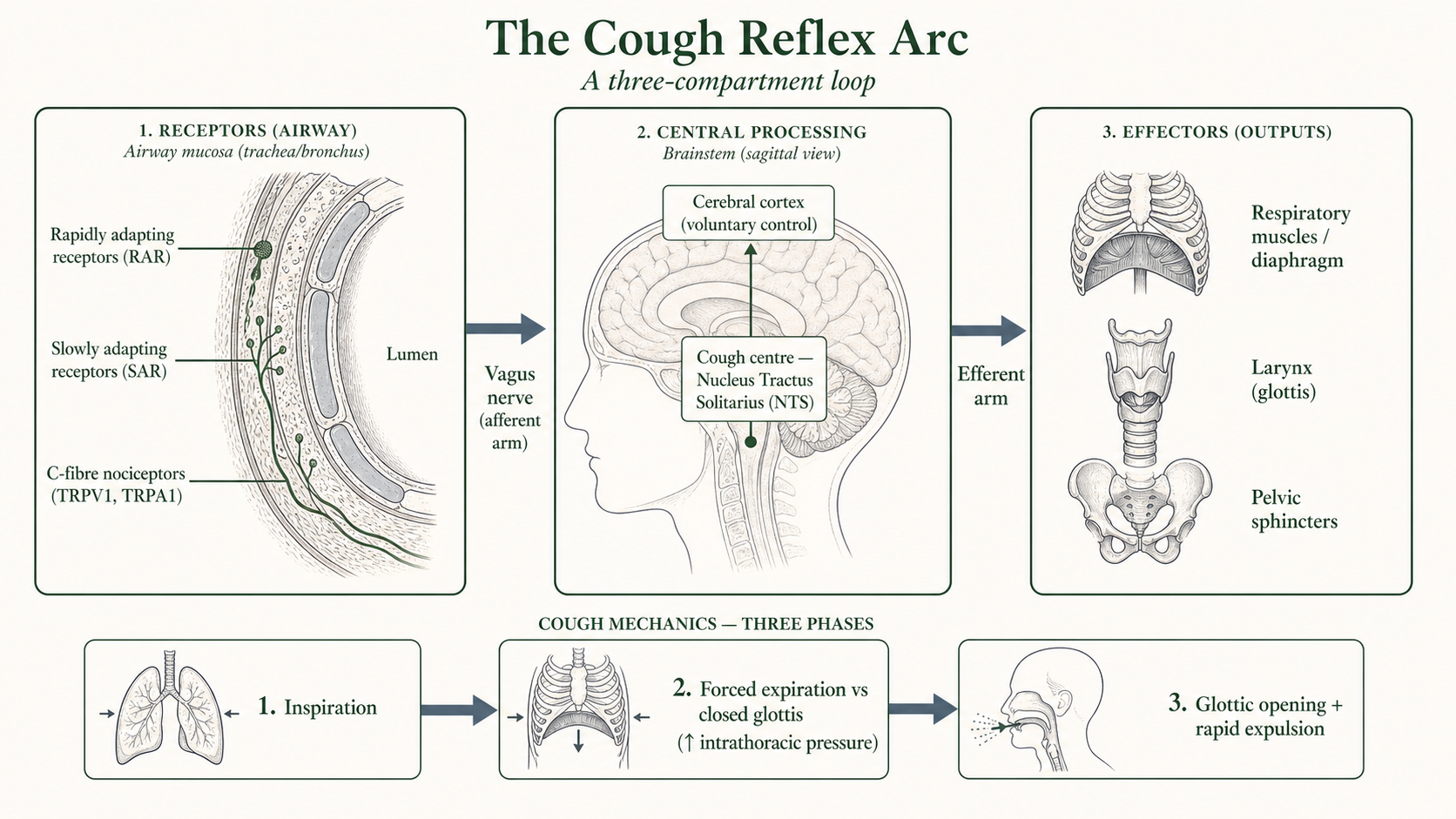
- Cough is a protective respiratory reflex whose purpose is expulsion of respiratory secretions and foreign particles from the air passages (KDT 8e Ch.16, p.237).
- It is also a host defence mechanism that prevents introduction of particulate matter into the lower airways and clears excessive mucus; it can be initiated voluntarily as well as reflexly (DiPiro 12e Ch.e13, pp.1–3).
- It is triggered by stimulation of mechano- or chemoreceptors in the throat and respiratory passages, or stretch receptors in the lungs (KDT 8e Ch.16, p.237).
- The respiratory epithelium is covered by beating cilia + an overlying mucus layer; the cilia propel mucus upward toward the larynx (mucociliary escalator). When mucociliary clearance is impaired (e.g. by smoking-induced ciliary damage), coughing becomes a compensatory clearance mechanism (DiPiro 12e Ch.e13, p.2).
- Cough may be useful or useless (KDT 8e Ch.16, p.237):
- Useful (productive) cough drains the airway — suppression is not desirable and may be harmful, except when the volume of expectoration achieved is small relative to the effort of continuous coughing.
- Useless (nonproductive / dry) cough serves no purpose and should be suppressed, particularly when it is unduly tiring, disturbs sleep, or is hazardous (KDT 8e Ch.16, pp.237–9).
- Governing principle — treat the cause, not the cough: since cough is a defensive reflex, undue suppression can cause more harm than benefit; suppression may be inappropriate in bacterial lung infection (G&G 14e Ch.44, p.892; Padmaja 7e Ch.31, pp.406–7; KDT 8e Ch.16, p.237).
- Adverse consequences of excessive/persistent cough (when it ceases to be protective): syncope, urinary incontinence, vomiting, chest pain, rib fractures, sleep disturbance, social embarrassment, depression, and impaired health-related quality of life (DiPiro 12e Ch.e13, p.1).
Continue reading
See plans
Cough Pharmacotherapy
PharmaNotes Pro · Comprehensive
₹199/monthMonthly
Save 16%₹1,999/yearAnnual
- Every LAQ and Comprehensive chapter, current and future
- Exam Prep: guided recall, recorded audio and nine PDFs
- The RGUHS recurring-question answer bank, Papers I–IV
Sign in with your Google account. If you're already subscribed, the chapter unlocks immediately — otherwise, pick Monthly or Annual on the next step.