Antiseptics & Disinfectants
Definitions, Classification, Mechanisms, Uses & Ectoparasiticides
Past RGUHS · 3
RGUHSNov '19
RGUHSJun '16
RGUHSApr '08
Antiseptics & Disinfectants
1. Definitions & terminology
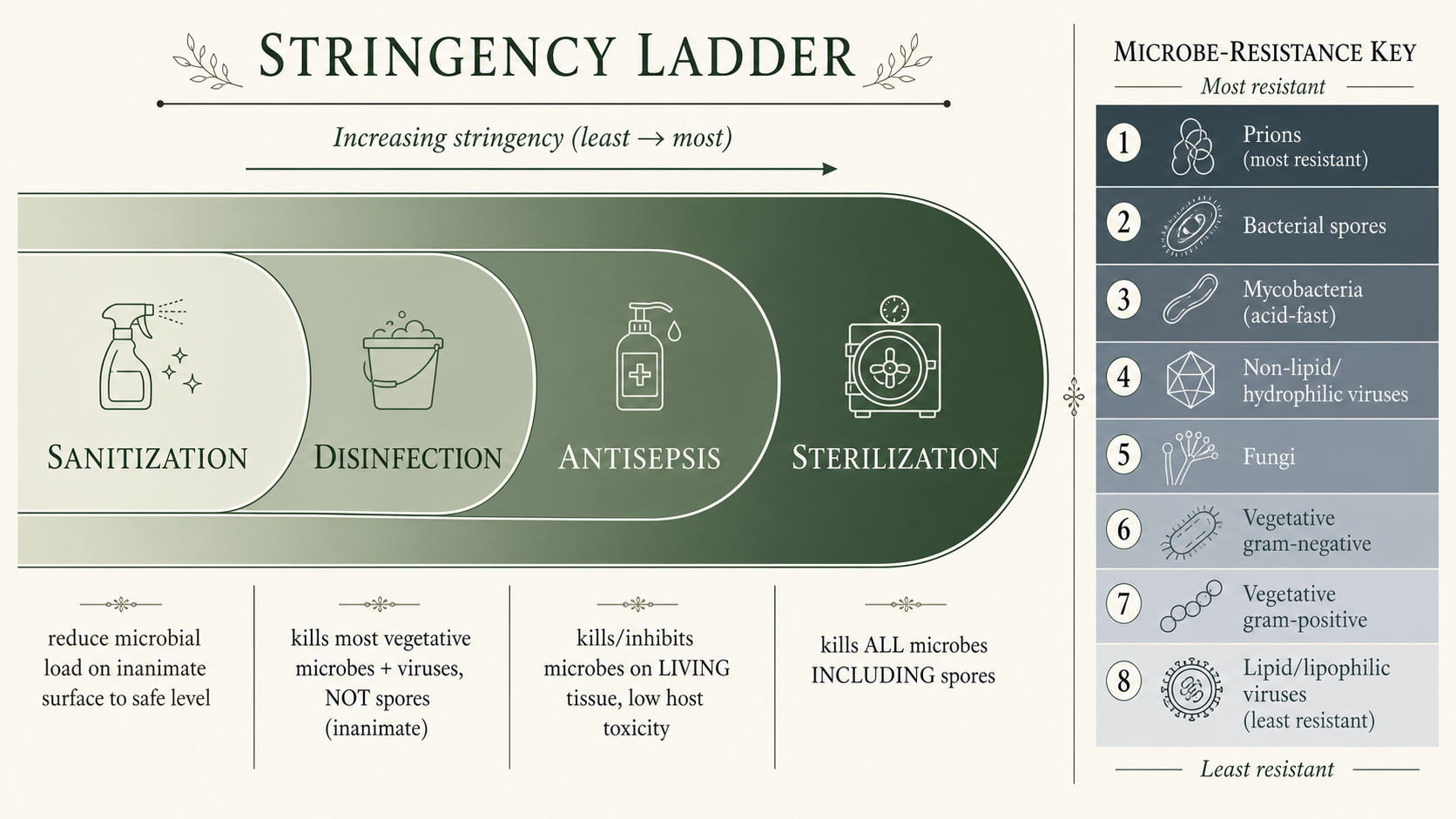
- Antiseptic vs disinfectant — both are agents that inhibit or kill microbes on contact; the distinction is conventional and based on the surface of application, not on intrinsic chemistry (KDT 8e Ch.67, p.957).
- Antiseptic — agent applied to living surfaces (skin, mucous membranes — mouth, wounds); has sufficiently low toxicity for host cells to be used directly on skin, mucosae or wounds (KDT 8e Ch.67, p.957; Katzung 16e Ch.50, p.947).
- Disinfectant — agent used on inanimate (non-living) objects — surgical instruments, surfaces, privies, water supply (KDT 8e Ch.67, p.957; Katzung 16e Ch.50, p.947).
- There is considerable overlap; many agents are used either way. A practical "static vs cidal" distinction between the two is futile because these actions are frequently concentration-dependent (KDT 8e Ch.67, p.957).
- Germicide — umbrella term covering both antiseptics and disinfectants (any agent that kills microbes) (KDT 8e Ch.67, p.957).
- Sterilant — agent (or physical process) that kills both vegetative cells AND spores when applied to materials for an appropriate time and temperature; the most stringent category (Katzung 16e Ch.50, p.947).
- Disinfection vs sterilization — a key examination distinction (KDT 8e Ch.67, p.957; Katzung 16e Ch.50, Table 50–2, p.948):
- Sterilization — a process intended to kill or remove ALL types of microorganisms, including spores (and usually viruses), with an acceptably low probability of survival.
- Disinfection — chemical/physical treatment that destroys most vegetative microbes and viruses but NOT spores, in or on inanimate surfaces; reduces viable pathogens to a level posing no risk to a host with normal defences. Disinfectants do NOT eliminate all microbes (do not kill spores).
- Related terms (Katzung 16e Ch.50, Table 50–2, p.948; KDT 8e Ch.67, p.957):
- Antisepsis — application of an agent to living tissue to prevent infection.
- Decontamination — a process producing a marked reduction in the number/activity of microorganisms.
- Sanitization — reduction of microbial load on an inanimate surface to a level acceptable for public-health purposes.
- Pasteurization — kills non-sporulating organisms by hot water or steam at 65–100 °C (Katzung) / moderate heat over time (e.g. water + moderate heat).
- Historical note — the era of antiseptics/disinfectants was heralded by Semmelweiss (hand-washing in chlorinated lime) and Lister (antiseptic surgery using phenol) in the 19th century (KDT 8e Ch.67, p.957).
- Distinction from systemic antimicrobials — germicides differ from systemically used antimicrobials by their low parasite selectivity — they are too toxic for systemic use. Some antibiotics (bacitracin, neomycin, mupirocin) are restricted to topical use but are conventionally not enumerated with antiseptics; a strict distinction is impossible (KDT 8e Ch.67, p.957).
Continue reading
See plans
Antiseptics Disinfectants
PharmaNotes Pro · Comprehensive
₹199/monthMonthly
Save 16%₹1,999/yearAnnual
- Every LAQ and Comprehensive chapter, current and future
- Exam Prep: guided recall, recorded audio and nine PDFs
- The RGUHS recurring-question answer bank, Papers I–IV
Sign in with your Google account. If you're already subscribed, the chapter unlocks immediately — otherwise, pick Monthly or Annual on the next step.