Alternatives to Animal Experiments
CPCSEA/CCSEA, the 4 Rs, and in-silico / in-vitro replacements
Past RGUHS + DNB + MPMSU · 13
RGUHSMar '26
RGUHSSep '25
RGUHSMay '25
DNBOct '24
DNBJun '22
RGUHSJul '21
RGUHSNov '20
RGUHSJun '20
MPMSUJul '20
DNBJun '20
MPMSUMay '18
MPMSU2016
RGUHSMay '10
Alternatives to Animal Experiments — CPCSEA & the 4 Rs
1. Definition, scope & why alternatives matter
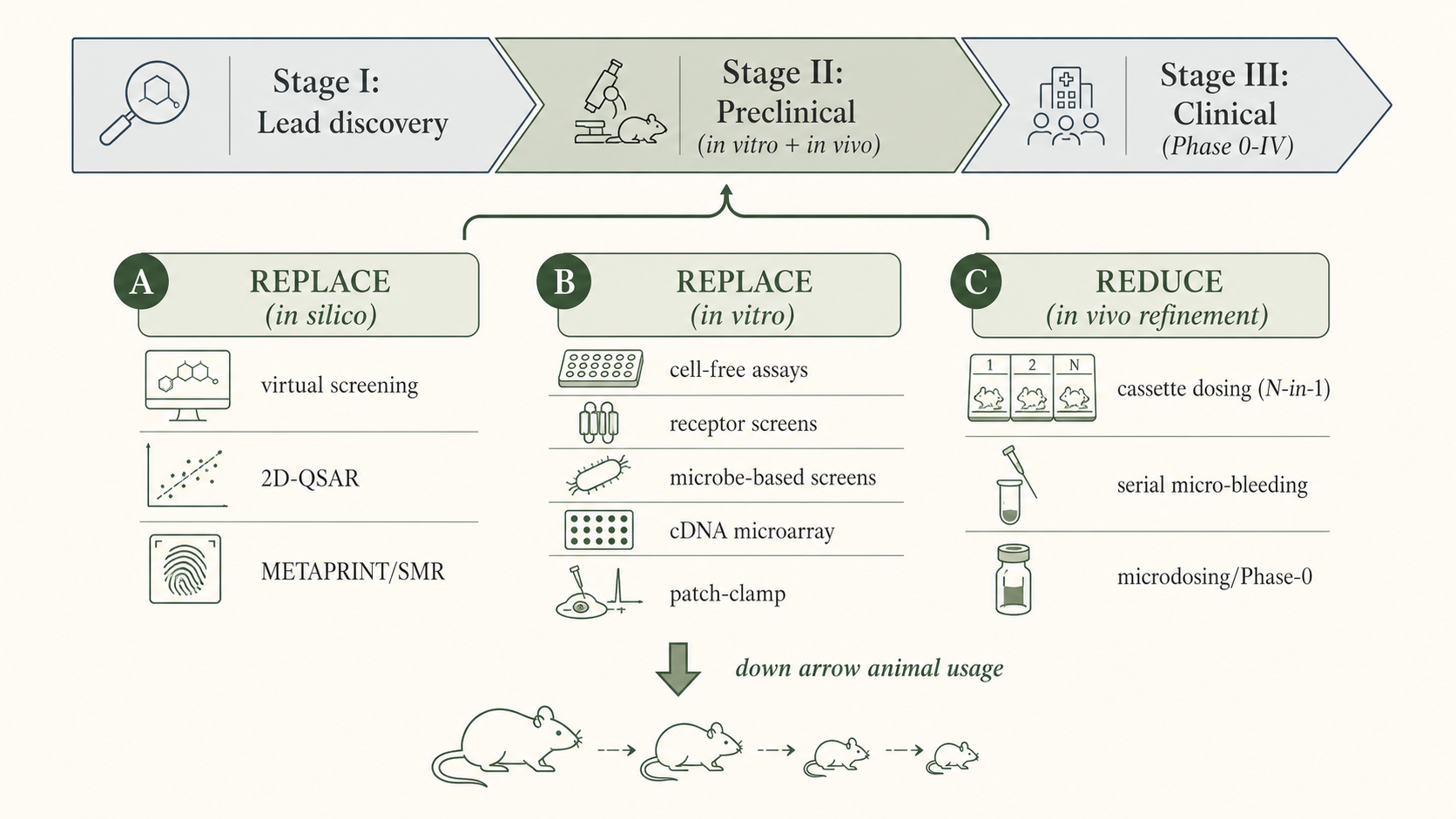
- The use of animals in biomedical research is common to understand fundamental molecular- and cellular-level aspects that in turn facilitate development of therapeutic measures for both animals and humans; medical researchers in particular face the recurring allegation that animal use "is not necessary" because new drugs can be developed in the test-tube, by computer (in silico) or by microdosing directly to healthy volunteers (Medhi Ch.1, pp.39–40).
- The understanding of the human body has come from more than 200 years of research on the function of normal cells, tissues and organs, and on disease processes; animal models are used to test possibilities that would be difficult or impossible to test in the target species (Medhi Ch.1, p.40).
- An animal serves as a valid model for another species when, despite their differences, the two strongly resemble each other in the particular feature under study — research with low animal suffering and high benefit is generally regarded as acceptable (Medhi Ch.1, p.40).
- Core ethical premise: "Each animal has the right to life and humans should not take such a right away from them." In a clinical setting, pain or suffering in a patient is unethical unless for that patient's direct benefit — the same standard applies to animals in experiments (Medhi Ch.1, p.39).
- Animal use in research can be minimized but cannot realistically be stopped entirely; where it continues, animals provide a vital contribution to fundamental scientific understanding that may yield future benefit (Medhi Ch.1, p.40).
- Selection of an animal model is one of the most important steps in any experimental pharmacological study — the model must reproduce a disease profile similar to humans, and follows three objectives: (1) use a species phylogenetically closer to man, (2) use a species in which the process under investigation is as close as possible to that in man, (3) the anatomy, physiology and biochemistry are similar (Medhi Ch.1, p.6).
- Two overarching governing principles of pharmacological products: (1) all therapies must meet the same standards of evidence of efficacy and safety in preclinical and clinical studies, and (2) substances used as drugs can be toxic under certain conditions (Medhi Ch.1, p.4).
Where animals sit in the drug-development pipeline (context for why alternatives target the preclinical stage)
- Drug development has three stages: Stage I — hit & lead-compound development (identify lead among millions of compounds); Stage II — preclinical studies (in vitro + in vivo animal experiments); Stage III — clinical studies (Phase 0, I, II, III, IV, V in humans) (Medhi Ch.1, pp.5–6).
- The aim of the preclinical stage is to find the Maximum Recommended Starting Dose (MRSD) for humans, via in vitro (cell line, enzyme inhibition) and in vivo (animal model) studies; the MRSD is then extrapolated with a safety factor to the Safe Starting Dose (SSD) before first-in-human dosing (Medhi Ch.1, p.6).
- Animal use is heaviest at Stage II (preclinical: pharmacodynamics, pharmacokinetics, acute/chronic/genotoxicity) — this is precisely the stage that in-vitro, in-silico and microdosing alternatives aim to replace or reduce (Medhi Ch.1, p.6; SK Gupta Ch.1, pp.1–4).
Continue reading
See plans
Alternatives To Animal Experiments
PharmaNotes Pro · Comprehensive
₹199/monthMonthly
Save 16%₹1,999/yearAnnual
- Every LAQ and Comprehensive chapter, current and future
- Exam Prep: guided recall, recorded audio and nine PDFs
- The RGUHS recurring-question answer bank, Papers I–IV
Sign in with your Google account. If you're already subscribed, the chapter unlocks immediately — otherwise, pick Monthly or Annual on the next step.